


Most hotel guests don't begin their booking journey on a hotel website. They begin on Booking.com, Expedia, or another OTA. They browse, compare, and shortlist. Then (and this is where it gets interesting), a growing number of them cross over to the hotel's own website to see if they can do better.
According to SiteMinder's 2026 data, Booking.com has overtaken Google as the number one starting point for hotel searches, with 26% of travellers beginning their research there. And according to Otamiser, 65% of all direct bookings come from guests who first discovered the hotel on an OTA.
This is the billboard effect in action. OTAs serve as the shop window; your website is where the real relationship begins. And the booking engine is where it's decided. When a guest lands on your site after finding you on an OTA, they're no longer just browsing—they're deciding. What happens at that moment determines whether the booking is yours or the OTA's.
OTAs are where guests find you, but not necessarily where they want to book
The OTA-first journey is now the default for most travellers. That doesn't mean guests prefer to book through OTAs. It means OTAs have become the most accessible research tool. They have a great range to choose from, show reviews, and offer a familiar interface that makes comparison feel easy.
But research and booking are different behaviours. A growing share of travellers use OTAs for discovery, then actively seek a better deal on the hotel's direct channel. Cornell University research found that hotels listed on OTAs see a 7.5% to 26% increase in direct bookings as a result of that OTA visibility. According to SiteMinder's Changing Traveller Report 2026, 18% of travellers who start their search on an OTA ultimately book directly, a figure that has risen 3.3 percentage points year-on-year.
Guests are making the effort to cross over. The question is whether your direct channel gives them a clear reason to stay when they do.

What determines whether guests stay or return to the OTA
When a guest navigates from an OTA to your website, they arrive with a specific purpose: to check whether booking direct is worth it. Price is the most immediate signal. If your direct rate is clearly better, the question is answered. If it looks the same or if the guest can't tell, the scales shift in the OTA's favour.
And the OTA has a structural advantage in a tie. The guest already has an account there, saved payment details, and a checkout experience they've used before. Familiarity reduces friction, and lower friction wins bookings. A hotel that achieves rate parity has done nothing technically wrong. But in a tie, the OTA could win by default.
This is why parity (matching OTA prices) is no longer enough to convert the guest who's already on your website.
The difference between matching OTA prices and beating them
Rate parity means having the same price across all channels, including on OTA sites. Price beating means being cheaper, and making that visible, at the right moment, without asking the guest to do any extra work.
The distinction matters because "same price" gives a guest no reason to leave the comfort of the OTA. "Better price here" does. One removes a barrier. The other creates a pull.
Price beating is not the same as blanket discounting. It isn't about permanently lowering your rates or running constant promotions. It's about responding automatically when a genuine OTA undercut exists. Closing the gap in real time, within the booking flow, without the guest needing to open another tab, copy a code from a different page, or take any additional steps.
The experience is frictionless: the guest sees they're getting the best available price, and they book.

Why the booking engine is the most powerful place to make this happen
87% of hotel bookings are abandoned before completion. That figure speaks to how fragile the final decision is, even when intent is high. A guest inside your booking engine has already made the most important choice: they've selected your hotel. What they haven't confirmed is where to book it.
This is the highest-value moment in the entire guest journey. Upstream efforts—rate monitoring, metasearch bidding, homepage messaging—all happen before the guest reaches this point. By the time they're inside the booking engine, those interventions are behind them. If an OTA is showing a lower rate at this stage, there's nothing in place to respond to it.
Price beating, applied inside the booking engine at the point of decision, protects the moment that matters most. It's not a replacement for a strong direct booking strategy. It's the final step that makes everything else pay off.
What this looks like for the guest
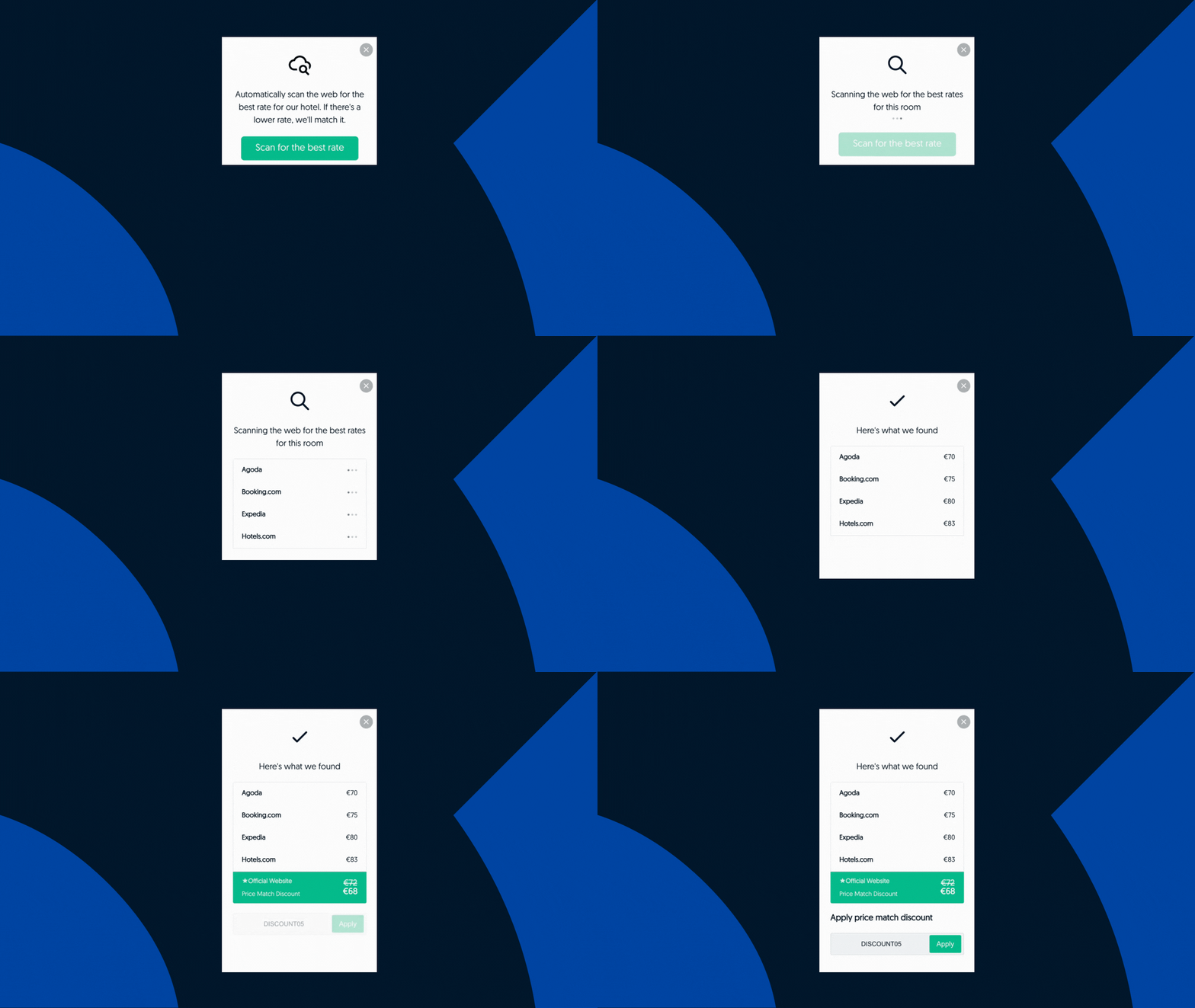
The experience is intentionally simple. OTA rates are scanned in real time. If a lower price is detected, a better direct rate is generated and offered immediately, applied via a discount code within the booking flow. The guest doesn't need to leave your site, compare tabs, or search for a promo code. The better rate appears, the gap closes, and the booking completes on your direct channel.
RateBeat is built specifically for this mechanic: real-time OTA rate detection, transparent price comparison, and instant price beating within the booking journey. The result is a guest who books with confidence and a hotel that keeps the booking without paying OTA commission.
The revenue case: why every recovered booking adds up
OTA commissions typically run at 15–25% of booking value. The cost of acquiring a direct booking is roughly 2–5%. The margin difference on a single €200-a-night reservation can be €20-€40—per booking, per night. At scale, across a full season of diverted demand, the numbers compound quickly.
Direct bookings also come with something OTA bookings don't: the guest relationship. Direct bookers are 60% more valuable over their lifetime than OTA bookers, because you have their contact details, their preferences, and the ability to build loyalty on your own terms rather than the OTA's.
A fast, on-domain booking engine that keeps the experience seamless removes the UX reasons a guest might leave. Price beating removes the pricing reason. Together, they make booking direct the obvious choice.

Getting it right: price beating without eroding perceived value
Price beating works because it's precise. It activates only when a genuine OTA undercut is detected. It isn't shown proactively to every guest or applied as a default discount. When there's no cheaper rate elsewhere, your direct price stands on its own merits.
Advanced audience targeting means different guest segments can be treated differently: returning guests, price-sensitive markets, mobile users checking rates on the go. This approach protects the perceived value of your rates while ensuring that guests who have already done their research and are actively considering booking direct always find a clear reason to do so.
The goal isn't to train guests to expect a discount every time. It's to ensure that when a guest crosses over from an OTA and looks for a reason to book directly with you, that reason is always there.
Stop losing guests at the final step
Guests are already finding you on OTAs and crossing over to your website. RateBeat ensures that when they do, your direct rate beats the OTA price — automatically, in real time, inside your booking flow.
Free for 2 months. No card required. Try RateBeat →

