


For much of the 2000s through to the mid‑2010s, rate parity was treated as a given. The price on your hotel website was expected to match the price on OTAs. That was the industry belief, reinforced by OTA contracts.
Parity was positioned as a signal of fairness, trust, and protection of direct bookings. In reality, many hotels simply pushed the same base rate to all channels via their channel manager. OTAs then layered on loyalty discounts, mobile rates, and targeted promotions, creating a gap between what hotels believed was happening and what guests actually saw.
Today, that assumption no longer holds.
Between regulatory changes, more aggressive OTA discounting, and the spread of price-matching guarantees, the ground has shifted for hotels. OTAs continue to operate with clear advantages, from layered discounts and price matching to the way listings are surfaced to guests. Having the same price everywhere no longer protects direct bookings, and in many cases, it creates a false sense of security.
This article breaks down what rate parity really means today, what has changed, and why hotels need to rethink how they protect their direct channel.
What rate parity actually means (and why it mattered)
Traditionally, rate parity meant offering the same public room rate, under the same conditions, across all distribution channels, including your hotel website and OTAs.
For hotels, this mattered because parity:
- Prevented OTAs from undercutting the direct channel
- Reduced guest confusion around pricing
- Helped protect direct conversion rates
For years, parity clauses embedded in OTA contracts enforced this balance. Hotels could confidently assume that if their website showed the same price, they weren’t losing bookings on cost alone.
That foundation has now shifted.
The regulatory shift that changed the rules
In Europe, the legal foundations of OTA rate parity have shifted significantly over the past decade.
Historically, many OTAs included so-called rate parity clauses in their contracts, requiring hotels not to offer lower public rates on their own websites or other channels. These clauses were designed to prevent price competition and keep OTA listings attractive, but they also limited hotels’ ability to differentiate their direct pricing strategies.
Over time, regulators and courts increasingly challenged this model. Several national competition authorities (most notably in Germany) ruled that wide parity clauses restricted competition. This culminated in a landmark judgment by the Court of Justice of the European Union (CJEU), which found that OTA parity clauses could restrict competition and were not automatically justified under EU competition law.
As a result, hotels in much of the European Union are no longer contractually bound to parity clauses in the form they once were. In principle, this gives hotels greater freedom to:
- Differentiate prices on their direct channel
- Run independent promotions
- Experiment with alternative pricing strategies
On paper, this looks like good news for hotels.
In practice, however, the landscape has become more complex. OTAs remain free to apply their own discounts and promotions, and ranking algorithms and visibility incentives continue to influence how hotels price across channels.
How OTAs actually operate today
Many hotels, particularly small and independent ones, still distribute the same base rate across all channels via their channel manager. It’s operationally simple and feels “safe”.
But OTAs rarely stop at the base rate. They routinely layer on additional mechanisms that change what guests actually see:
- Loyalty pricing (e.g. Genius discounts)
- Mobile-only rates
- Targeted promotions
- Market-specific campaigns
- And increasingly, price-matching guarantees
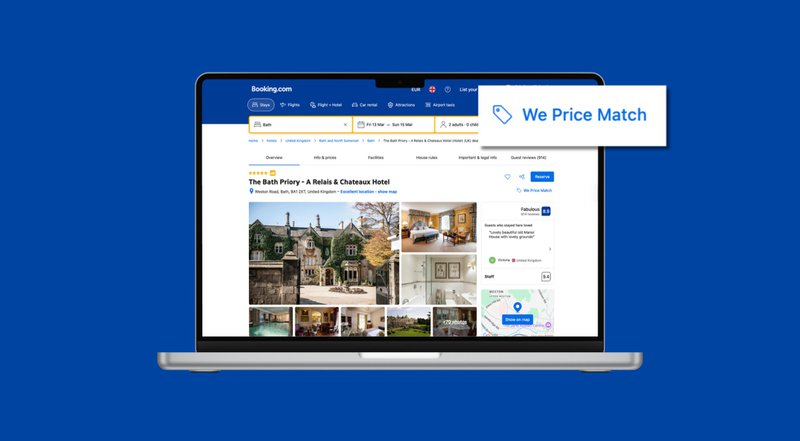
Price matching has become the final piece of the puzzle. In many cases, OTAs offer “best price guarantees”, where guests can claim a refund if they find a lower rate elsewhere, sometimes even on the hotel’s own website. The result is that even when a hotel undercuts an OTA, that advantage can quickly be neutralised. For guests, this changes behaviour. They may still visit the hotel website and check prices, but price is no longer a decisive reason to leave the OTA environment.
The outcome is that hotels are often undercut—or effectively matched—without realising it. Many only discover the issue when a guest flags it, by which point the booking decision has already been made.
Why “just being cheaper” no longer works
At this point, the issue is no longer whether hotels can be cheaper; it’s whether that price advantage is visible, trusted, and meaningful to guests.
Because those OTA mechanisms sit on top of base rate, being marginally cheaper on your own website rarely changes behaviour on its own. Guests may still check prices, but price alone is no longer enough to pull them out of the OTA flow.
The real impact shows up in conversion. When guests perceive that a better or safer deal exists elsewhere, confidence drops, and so does the likelihood of booking direct. In other words, rate parity today is as much about trust as it is about price.
Price has become table stakes. What determines conversion is not simply being cheaper, but giving guests a clear reason to believe that booking direct is the better choice.
Looking ahead
Rate parity hasn’t disappeared, but it has changed shape.
Today, having the same price everywhere is no longer enough to protect direct bookings. Parity is less about identical rates and more about how guests feel when they are about to book.
In practice, that means:
- Guests are looking for reassurance, not just a lower number
- Small price differences are quickly neutralised
- Trust and perceived value matter as much as price itself
OTAs continue to operate with clear advantages, from layered discounts and price matching to the way listings are surfaced to guests. When hotels rely on passive parity assumptions, direct bookings are left exposed.
The challenge now isn’t simply to match prices: it’s to protect the direct channel in a way guests clearly understand and trust.
Want to understand where your rates are being undercut, and how to fix it? Discover how RateBeat can help you stay competitive and get more direct bookings.

