


You've invested in your website, your booking engine, and your marketing. You're confident your direct price is competitive. Then a guest otherwise ready to book checks your price against OTAs, only to find it’s €10 less than what your own site showed.
Here's the uncomfortable truth: that's not a one-off. According to the World Parity Monitor Annual Edition 2025, in 75% of global hotel searches, at least one OTA displays a lower price than the hotel's own website.
The even harder part? Most hotels don't see it happening.

Why pricing control slips away, and where to look
Losing control of your pricing isn't usually a single decision. It happens gradually, across your distribution network, and often in ways that are hard to spot from your own desk.
- Wholesaler and bed-bank leakage is the most common culprit. B2B net rates negotiated for packaging purposes get unbundled and resold as standalone rates on consumer-facing sites. Research from Expedia Group found that 49% of wholesale sales end up with unintended partners, and 48% of unauthorised resellers list those rates publicly.
- Mobile and geo-targeted discounts are harder still to spot. The World Parity Monitor found OTAs undercut hotel direct rates in 38% of mobile searches versus 31% on desktop. A rate that looks perfectly matched when your revenue manager checks from Amsterdam might be showing €15 cheaper in Singapore (on mobile, via a geo-targeted OTA promotion your hotel never approved).
- OTA-funded member discounts (Booking.com Genius, Expedia One Key, Agoda's logged-in rates) have the same practical effect as a parity breach, even though they're technically funded from the OTA's own margin.
There's also a channel-sprawl problem. The more partners you work with, the harder it becomes to ensure everyone is playing by the rules. Pricing control and channel volume are often in direct tension.
"Managing too many selling channels doesn't lead to more optimised revenue. It makes it harder to control your rates. Selecting partners based on top-selling volume and lowest commission margin is a more sustainable approach." — Vendy Prihayana, Account Executive at Hotelchamp
The regulatory picture: good news in Europe, caution everywhere else
There has been a meaningful regulatory shift in Europe. As of September 2024, following the EU Court of Justice ruling in Case C-264/23 and Booking.com's removal of contractual parity clauses across the EEA, hoteliers in the EU are no longer legally bound to match OTA prices on their own websites.
That's a genuine win, and the data shows it's starting to matter. The "lose rate" measures how often a hotel's own website is undercut by an OTA. In EU markets, that figure fell from around 20% in 2023 to approximately 15% by September 2025, meaning fewer hotels are being undercut on their home turf. Outside the EU, where parity rules still apply, the rate held steady at 20–21%. The gap between the two regions is widening, and it's largely down to regulation doing its job.
But it's not a clean break. OTAs still reward price parity through their ranking algorithms. Hotels that offer lower direct rates risk being deprioritised in search results, excluded from Genius or Preferred placement, and effectively made harder to find, without any formal contractual violation. The legal constraint is gone; the commercial incentive to comply remains.
Outside Europe, the picture is more complex. Rate parity clauses remain contractually enforceable in the US and most of Asia. And the frustration with the status quo is real. By August 2025, over 15,000 European hotels had joined HOTREC's class action lawsuit against Booking.com, seeking compensation for the impact of parity clauses going back to 2004.
"Rate parity compliance shouldn't mean handing away your pricing power. Hotels that understand what they're actually required to do (versus what they've assumed) often find more room to compete directly than they realised." — Jasmine Woon, Customer Success Manager at Hotelchamp
Build a direct value proposition that OTAs can't replicate
Where you can't always win on price, you can win on value, and the evidence suggests that's often the more powerful lever anyway.
SiteMinder's Changing Traveller Report 2026, covering 12,000 travellers across 14 countries, found that 18% of travellers who begin their search on an OTA ultimately book direct, with control and service rather than price as their primary reasons. That figure is up 3.3 percentage points year-on-year. Guests are increasingly willing to book direct when the experience clearly justifies it.
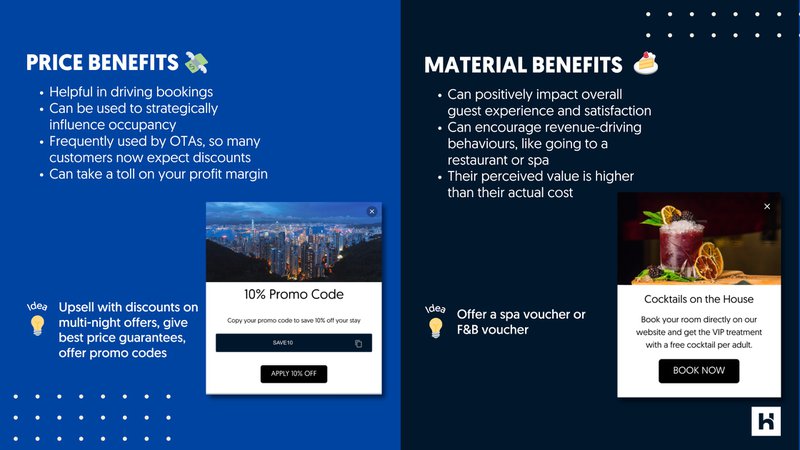
- Exclusive member rates are one of the most effective tools available, regardless of where you are in the world. A rate available only behind a login wall is invisible to OTA scrapers and outside most parity clause definitions (which typically govern publicly available rates). Guests who create a direct account get a better price.
- Tangible perks convert better than most hoteliers realise. Industry research shows 48% of travellers say a free room upgrade would convince them to book direct, and 55% are swayed by free meals or drinks. Late checkout, flexible cancellation, a welcome amenity: these often cost less than the OTA commission you'd save on the same booking, while creating a perceived value that sticks.
- Personalisation matters too. Showing a returning guest something different to a first-time visitor—a loyalty rate, a relevant package, a welcome-back message—makes the direct booking experience feel bespoke in a way that any OTA, with its standardised listing format, simply can't match.
"What actually works is making the benefits of booking direct clear and unmissable: member rates, exclusive perks, flexible options. Hotels need to give guests a genuine reason to choose direct, not just match what's already out there." — Vendy Prihayana, Account Executive at Hotelchamp
Make your rate visible and competitive at the moment of comparison
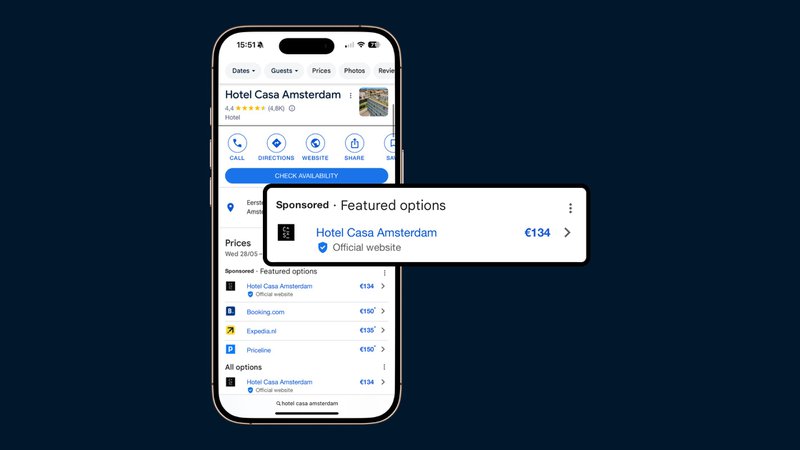
Most guests compare prices before they book. That comparison happens on metasearch platforms (Google Hotel Ads, Trivago, Kayak) where your direct rate sits right next to every OTA offering the same room. If you're not showing up there, or if your rate looks higher, you've lost the booking before the guest even reaches your website.
The good news is that the economics of metasearch are structurally in your favour. Where OTA commissions typically run at 15–25% of booking value, metasearch distribution costs average 3.5–4.5%. The traffic that comes through is also higher quality. Guests arriving via metasearch have already compared prices and chosen to click your direct link, which means intent is high. The key variable is whether your rate gives them a reason to follow through.
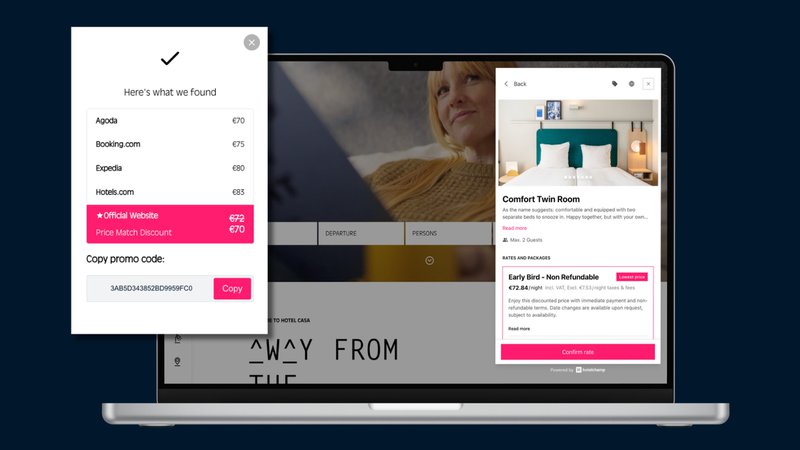
That's where Hoterlchamp’s RateBeat comes in. It monitors OTA rates in real time and automatically surfaces a personalised discount code on your website, giving guests a price that beats what they'd find on any OTA, so you're never losing a booking to a rate gap you didn't even know existed.
Siobhan from our Customer Success team has seen this dynamic play out repeatedly with hotels where OTA undercutting was severe, sometimes by as much as €80 on a single night:
"In some of the most severe cases we've seen, the resolution was a combination of two things: addressing the source of the leak with wholesalers, and making sure the direct site was showing a compelling value story early in the booking journey (seasonal offers, price comparisons, direct benefits) so guests had a clear reason to stay on the hotel's own site rather than go back to an OTA." — Siobhan Dillon, Customer Success Manager at Hotelchamp
Monitor your rates and act when something's off
Manual rate checking doesn't scale. If your revenue manager is logging into OTAs one by one, from a single location, on a desktop browser, they're seeing a fraction of what guests actually see. Mobile rates, geo-targeted promotions, and late-night flash discounts will all slip through.
- Automated rate monitoring gives you real-time visibility across channels and devices simultaneously, showing the gaps your revenue manager would never catch manually, and identifying which partner is the source. And when a guest does land on your website having spotted a lower OTA rate elsewhere, RateBeat ensures they're shown a personalised code to beat it on the spot, turning a potential lost booking into a direct one.
- When you find a problem, the response needs to be decisive. Industry consensus is consistent: once you've identified a partner that's systematically undercutting your direct rate, the most effective resolution is to address it at the contract level and, if the behaviour continues, to end the relationship. Continuing to distribute through channels that leak rates undermines every other investment you're making in the direct channel.
The cost of inaction is also higher than it looks. SHR's study of 27 million paid search impressions found that hotels allowing OTAs to undercut their direct rate pay, on average, 47% more per click for their own brand name in paid search.

The bigger picture: control builds on itself
Pricing control isn't just a revenue management issue. It's a brand issue. A guest who finds a lower rate on an OTA after they've already booked direct loses trust: not just in the channel, but in you. And a guest who consistently finds your direct rate is the best available becomes a direct booker by default.
The direct channel already wins head-to-head in 45% of rate comparisons globally. With the right strategy in place, that number can grow. And the effect on net revenue, guest data, and lifetime value is substantial.
Control doesn't mean abandoning OTAs. It means using them on your terms.
Stop losing bookings to rate gaps you can't see
If OTAs are undercutting your direct rate, you're losing bookings you should be keeping. RateBeat monitors competitor rates across channels in real time and automatically matches them on your website, so guests always see your best direct price.
No manual checks. No missed opportunities. Just a direct channel that competes.
See how RateBeat works.


.svg)

.svg)
