


For years, hotels have tried to solve rate parity issues by showing guests how their prices compare to OTAs. The assumption is simple: if guests see that the hotel’s rate is competitive, they’ll book direct.
In reality, price comparison doesn’t always work that way.
When OTAs appear cheaper, some tools surface that difference directly on the website, while others don’t appear at all. Either way, guests are left with uncertainty at critical moments in the booking journey.
In this article, we’ll explore why price matching is a more effective way to address this problem, and how hotels should think about using it as part of their direct booking strategy.
Price comparison vs price matching
Price comparison is designed to show guests how a hotel’s rates stack up against OTAs. Price matching is designed to resolve the differences when they matter.
In theory, price comparison sounds helpful. In practice, it behaves differently depending on the situation.
When a hotel’s rate is worse than an OTA’s, some comparison widgets will explicitly surface that difference on the website — for example, by showing that a cheaper rate exists elsewhere. Other tools simply don’t appear at all in this scenario.
In both cases, the outcome for the guest is similar: uncertainty. Either they’re shown that a better deal exists elsewhere, or they’re left to wonder whether they could find a lower price by leaving the site.
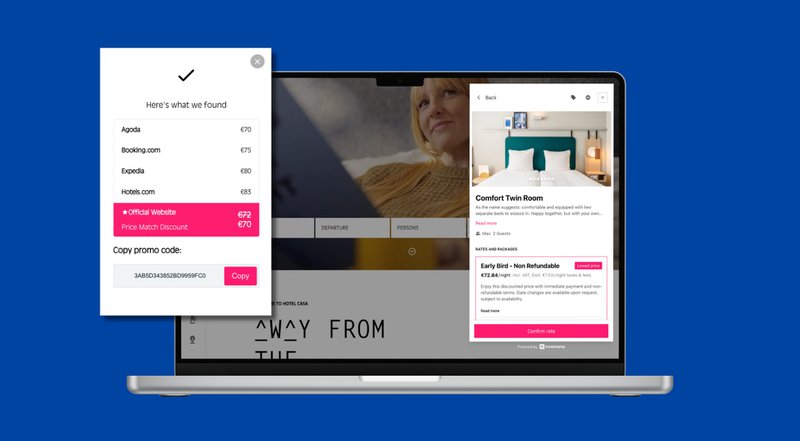
Price matching takes a different approach. When a genuine lower OTA rate is detected, the hotel can:
- Match that rate directly on its own website
- Apply a targeted rate‑matching code
- Keep the booking journey uninterrupted
Instead of signalling a problem and leaving the guest to resolve it, price matching addresses the issue in the moment. The guest doesn’t need to search for a better deal: it’s already there.
Why price matching has become essential for hotels
Price matching has become a baseline expectation across the booking journey.
OTAs have long combined multiple pricing tactics, from discounts and mobile-only offers to closed-user-group rates. Increasingly, hotels are responding by offering price matching on top of their existing pricing strategies.
This shift reflects how guests now evaluate prices. They expect that if a better rate exists, it should be easy to spot without extra effort on their part.
As Amber, Head of Solution Architecture at Hotelchamp, puts it:
“Guests have been trained by OTAs to expect pricing issues to be resolved for them. When hotels only show a comparison, it still leaves work for the guest. Price matching removes that friction, without forcing hotels into blanket discounting.”
For hotels, this changes the role of parity tools. Simply showing a comparison doesn’t align with how guests now experience pricing elsewhere.
Price matching allows hotels to meet these expectations on their own terms. It sits alongside existing discounts and offers, enabling hotels to resolve pricing discrepancies directly on their website while staying in control of when, how, and for whom matching is applied.
Guest‑friendly price matching without eroding value
From a guest’s perspective, booking should feel simple and reassuring. Anything that introduces doubt, like conflicting prices, disappearing signals, or extra steps, increases friction.
Price matching works because it:
- Removes the need for guests to compare tabs
- Keeps them in the booking flow
- Reinforces trust in the hotel’s direct channel
Instead of saying “we think our rate is competitive”, the hotel proves it. At the same time, price matching doesn’t have to mean giving away margin.
One of the biggest concerns hotels have is erosion of value: if every lower price is matched indiscriminately, guests can be trained to wait for discounts. That’s why effective price matching isn’t blanket discounting.
Done well, it is:
- Triggered only when a genuine undercut is detected
- Applied selectively (for example by channel, device, or audience)
- Designed to protect perceived value, not undermine it
This allows hotels to stay competitive without turning price matching into a race to the bottom, while still delivering a guest experience that feels trustworthy and brand‑safe.
Price matching as part of a wider direct strategy
Price matching works best when it’s not used in isolation, but as part of a broader direct strategy.
- Clear rate visibility
- Strong value messaging
- A booking experience that feels trustworthy
When these elements work together, price matching becomes less about fighting OTAs and more about protecting the integrity of the direct channel. It’s about ensuring guests don’t have a reason to leave your site in the first place.
The takeaway
Price comparison highlights the problem. Price matching solves it. For hotels serious about direct revenue, the goal is to make booking direct the easiest and safest choice for the guest. And that’s what effective price matching enables.
Want to understand where your rates are being undercut, and how to fix it? Discover how RateBeat can help you stay competitive and get more direct bookings.

